An agentic automation that classifies every website form submission the moment it arrives, analyzing the submitter against the ideal customer profile and routing them in HubSpot as qualified, unqualified, or spam before anyone on the sales team opens their inbox.
The Problem
Every website form submission lands in HubSpot looking the same. A qualified agency lead who needs white-label HubSpot support sits in the same list as a spam bot from a link farm and a freelance designer who found you through a Google search without understanding what you actually sell. They all have a name, an email, maybe a phone number, and a comment that may or may not be useful.
Someone on the sales team has to look at each one and make a judgment call. Is this an agency? Do they work with HubSpot? Are they in a market we serve? Is this email address from a real company or a generic Gmail? Is this phone number consistent with where they say they're from? Are their comments asking about our services or trying to sell us theirs?
For a clearly qualified lead, this takes 30 seconds. For an ambiguous one, it takes several minutes of investigation. For obvious spam, it's wasted time just confirming what was obvious from the subject line. Now multiply that by every form submission across the week. At 10 submissions per day, someone spends 30 to 60 minutes just triaging. At 25 per day, it's a multi-hour daily exercise. And two problems emerge that the math alone doesn't capture. First, qualified leads aren't being contacted as quickly as they should be because they're mixed in with noise that consumes the sales team's attention. Second, the qualification itself is inconsistent. What one person considers "probably spam," another person would investigate further.
Every agency owner knows the feeling: checking the CRM on a Monday morning, scrolling through a weekend's worth of form fills, knowing that somewhere in that list is a lead who was ready to buy on Friday and has already moved on. Not because the lead wasn't good. Because nobody got to it fast enough.
The bottleneck isn't finding leads. It's separating signal from noise quickly and consistently enough to respond before the lead goes cold.
How It Works
Step by Step
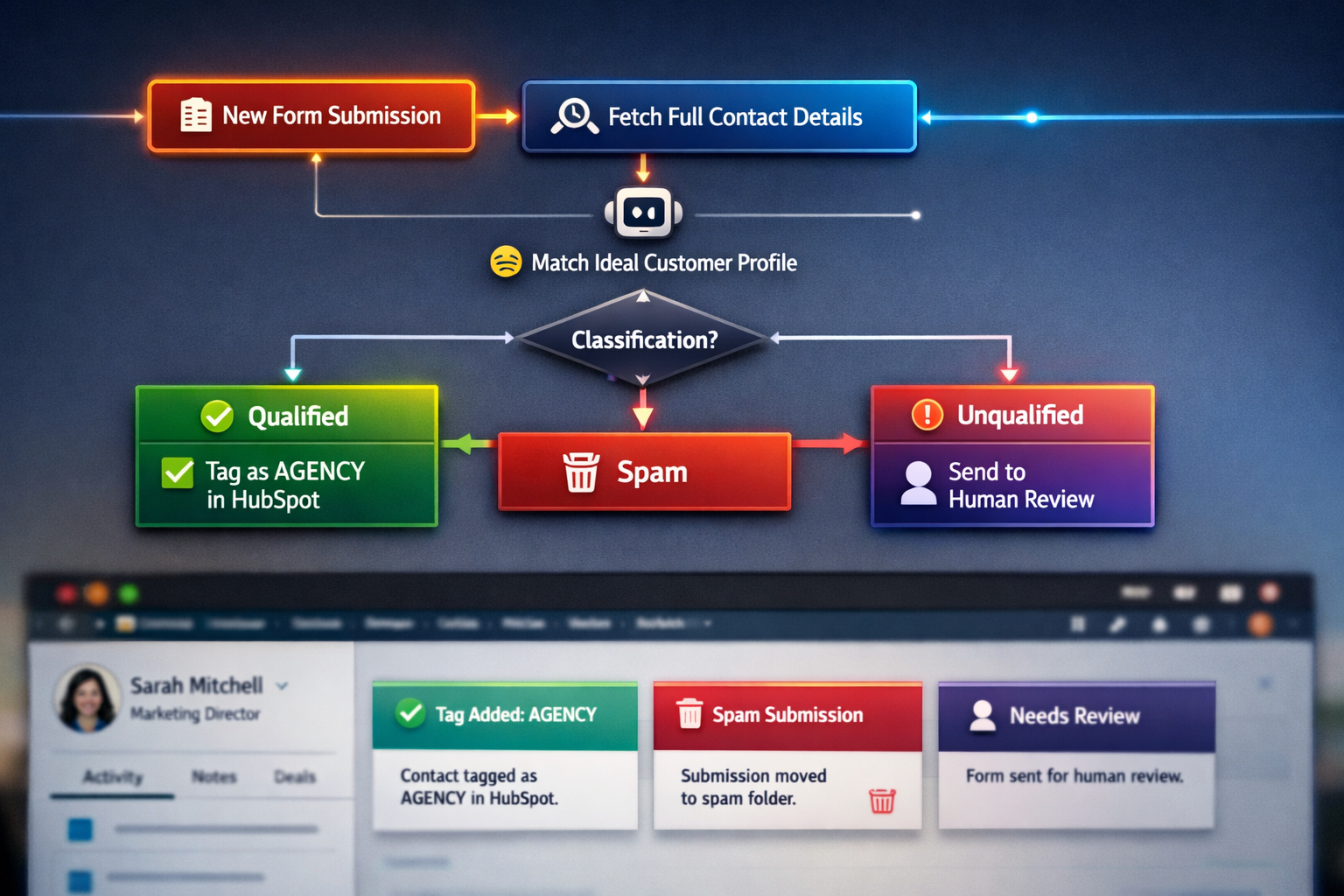
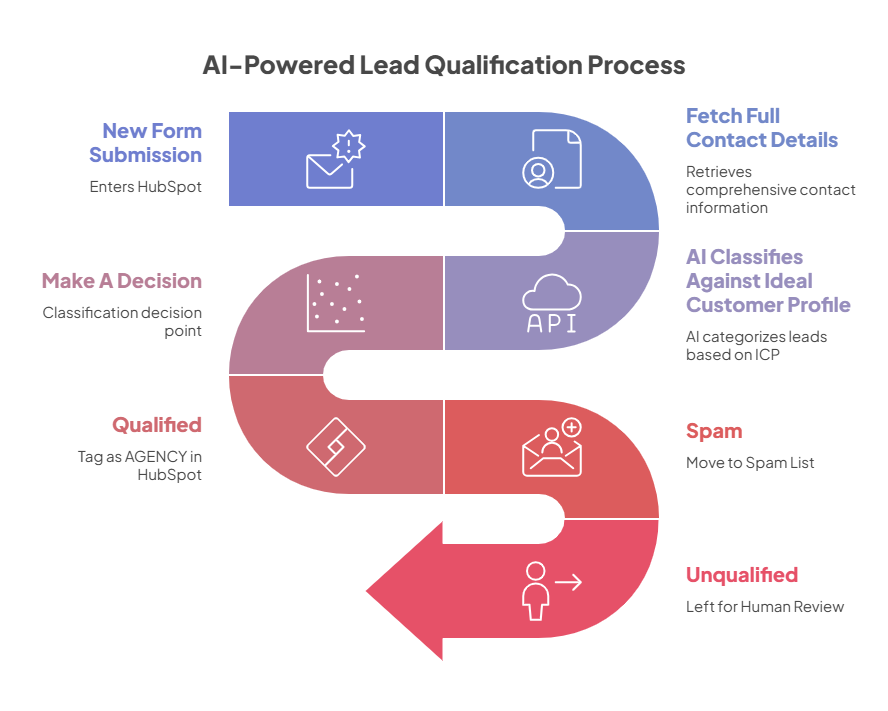
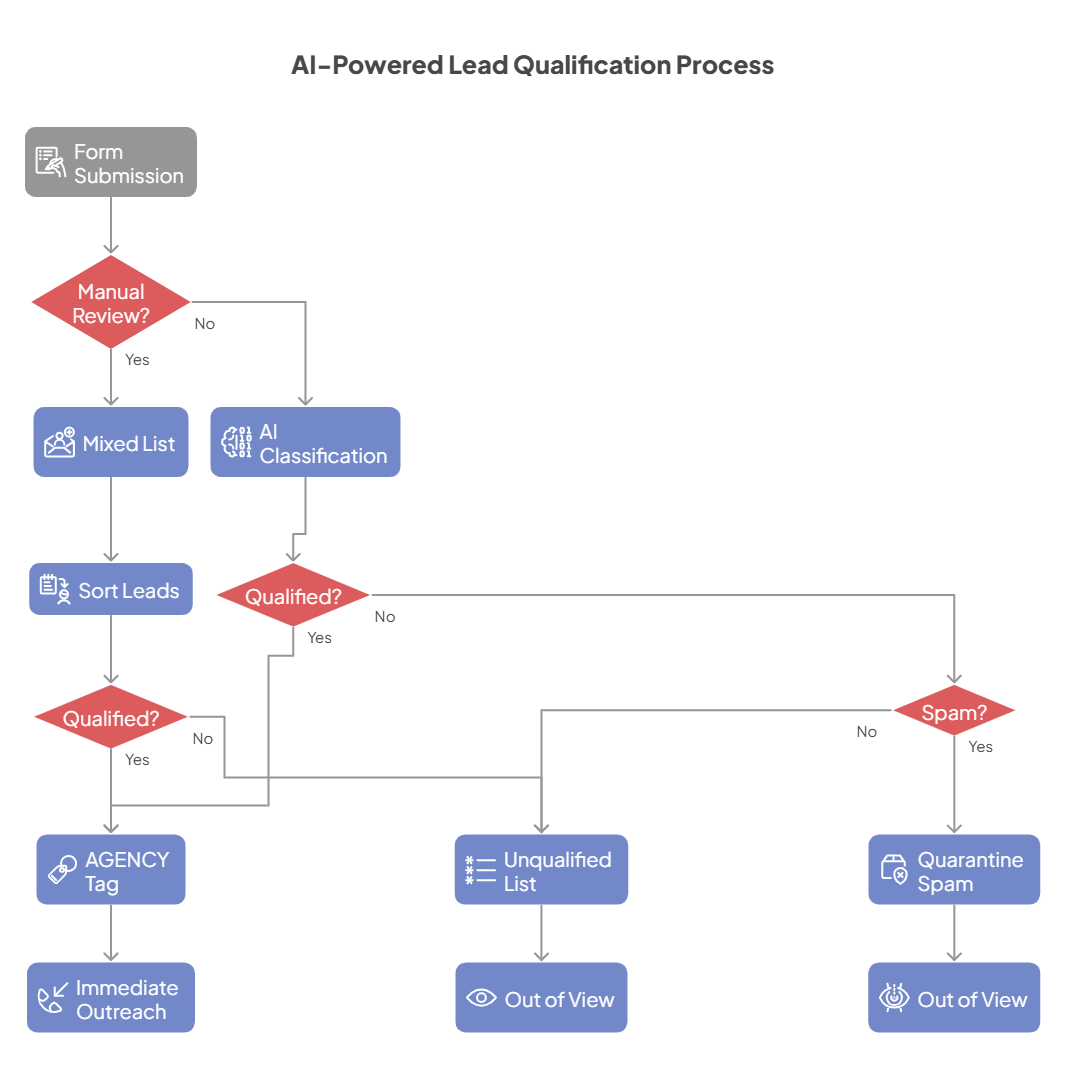
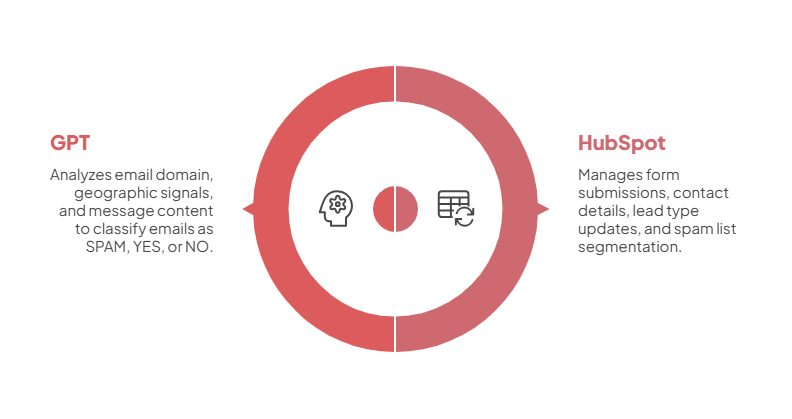
A new form submission arrives and enters the qualification pipeline. HubSpot detects when a new contact is added to the form submissions list. The automation immediately pulls the contact's full details: email address, phone number, geographic location, website (if provided), and any comments they submitted.
AI analyzes the submission against the ideal customer profile. The contact details are sent to GPT with a comprehensive briefing that encodes institutional sales knowledge: who Meticulosity is (a white-label HubSpot agency for other agencies), what services they offer, who the ideal customer is (marketing agencies, especially HubSpot partners, primarily in North America, UK, Australia, and New Zealand), and what spam indicators look like (geographic mismatches, generic email domains, unsolicited sales pitches). The AI extracts the website domain from the email address, evaluates the submitter's likely identity, and returns a single-word classification: SPAM, YES, or NO.
Qualified leads are tagged and ready for outreach instantly. Contacts classified as "YES" get their HubSpot record updated with a lead type of "AGENCY," immediately flagging them for sales follow-up. This tag can trigger downstream CRM workflows: assignment to a sales rep, enrollment in an agency-specific nurture sequence, inclusion in targeted reporting. The lead is warm, identified, and actionable before anyone manually reviews the list.
Spam is quarantined, not deleted. Contacts classified as "SPAM" are moved to a dedicated spam list, removing them from the active pipeline without destroying the record. This preserves an audit trail. The AI's classification can be reviewed, and false positives can be recovered. No data is lost.
Unqualified contacts are flagged for human judgment. Contacts that don't match the ideal profile but aren't spam pass through with no automated action. The AI flagged them as not matching, but a human can still take a second look. This three-way design is deliberately conservative: clear wins and clear losses are handled automatically, while edge cases get the human judgment they deserve.
The Outcome
Before |
After |
|---|---|
|
Every form submission requires manual review to determine if it's worth pursuing |
AI classifies each submission instantly: qualified, spam, or unqualified |
| Qualified leads sit in a mixed list alongside spam until someone sorts them | Qualified leads are tagged as AGENCY the moment the form is submitted |
| Spam contacts clutter the active pipeline and consume review time | Spam is automatically quarantined to a dedicated list, out of the sales team's view |
| Qualification consistency depends on who reviews the submission and when | Every submission is evaluated against the same criteria, every time, with zero variance |
| Response time to qualified leads depends on how quickly someone gets to the list | Qualified leads are identified and routed in seconds, not hours, ready for immediate outreach |
What this means in practice
This is not a notification system that tells the sales team "hey, you have new leads." It takes real action in HubSpot: tagging qualified contacts, quarantining spam, enriching records with classification data that the rest of the CRM can act on. The moment a form is submitted, the pipeline is already being organized. That's the difference between an alert and an agentic workflow. One tells you there's work to do. The other does the work.
The three-way classification is the responsible AI angle that makes this trustworthy at scale. The automation handles the clear wins (obvious agencies) and clear losses (obvious spam) with confidence. Ambiguous contacts are deliberately left for human review. The AI handles the volume; your team handles the judgment calls. It's the best of both worlds: speed and consistency on the straightforward cases, human nuance on the ones that need it.
At 5 form submissions per day, manual triage is manageable if tedious. At 20 per day, that's 100 per week, and someone is spending hours just separating signal from noise. At 50 per day across multiple campaigns, you either need a dedicated triage person or leads go cold waiting. This automation handles any volume with the same speed, the same criteria, and the same consistency. Whether you get 5 submissions this week or 500, every qualified lead is flagged before anyone on the sales team opens their inbox.
Systems Involved
Why This Matters for Agencies
The first five minutes after a form submission are the highest-intent moment in the sales process. Every minute between "form submitted" and "sales rep reaches out" reduces conversion probability. For agencies running multiple campaigns, attending conferences, or scaling their inbound engine, the volume of form submissions grows faster than the team's ability to triage them. The gap between "lead arrived" and "lead was qualified" is where pipeline velocity dies.
This automation eliminates the triage step entirely. The lead is classified, tagged, and routed before anyone on the sales team even knows it arrived. Qualified leads are flagged and actionable. Spam is gone. Unqualified contacts are noted for review. The sales team's first interaction with a new form submission isn't "is this worth my time?" It's "here's a qualified agency lead. Make the call."